Revolutionizing Toxinology?

Introducing Augmented Molecular Toxinology (AMT)

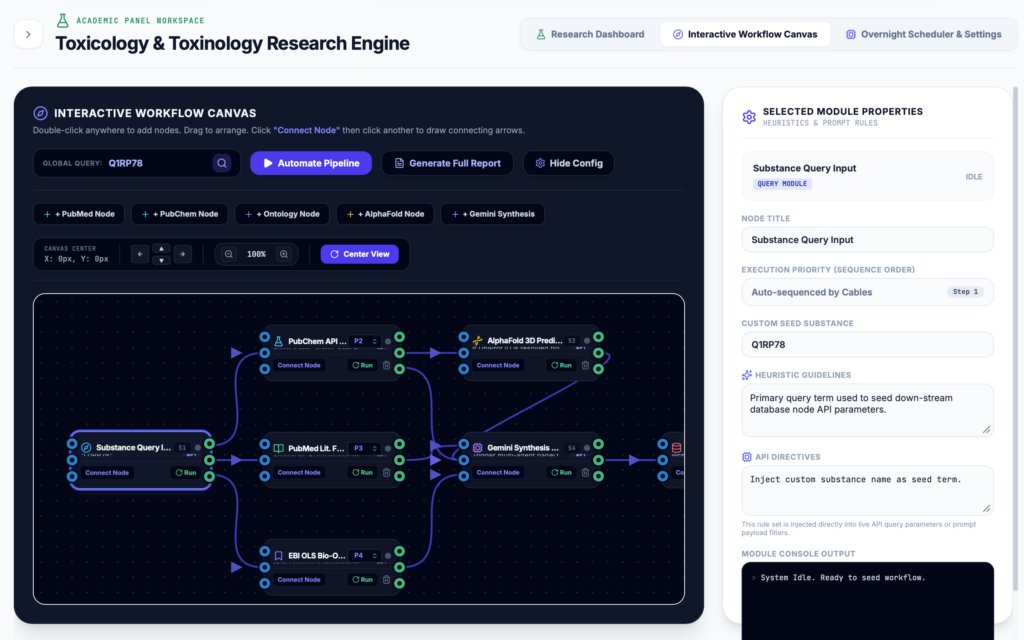
Traditional clinical envenomation care is stuck in a crisis, relying on reactive, symptomatic care models and unstable, animal-derived polyclonal antivenoms. This outdated paradigm leaves victims highly vulnerable to Envenomation-Induced Senescence (EIS), a silent, chronic tissue decay driven by the long-term biophysical persistence of un-neutralized toxins. Furthermore, emerging scientific discoveries are bottlenecked by a ten-to-fifteen-year clinical pipeline and profound cognitive fatigue from manual literature synthesis. We are introducing Augmented Molecular Toxinology (AMT) to bridge this translational gap.

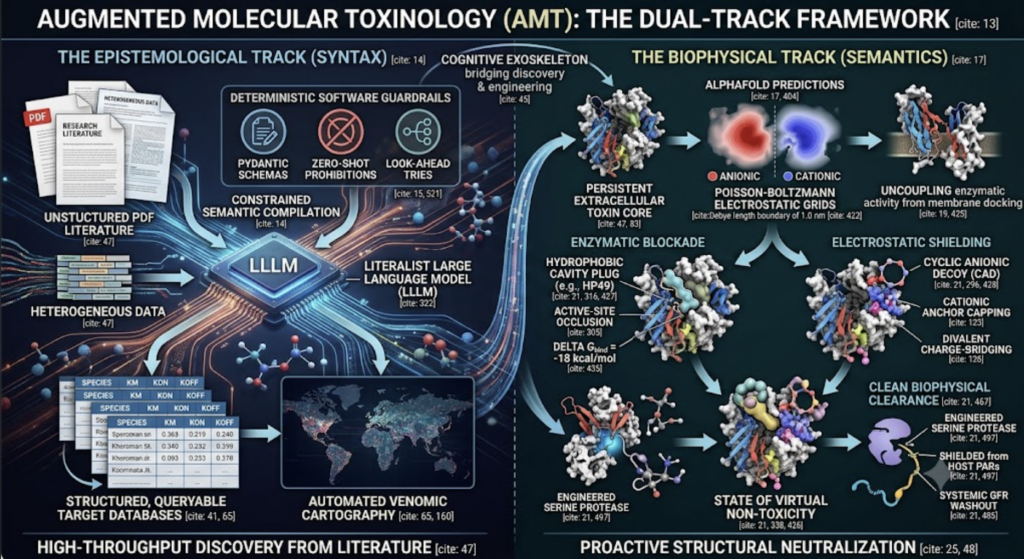
AMT is proposed as an emerging, unified, and interdisciplinary scientific branch designed to bridge the gap between in silico literature curation and de novo biophysical engineering. It shifts the paradigm of envenomation care from passive, reactive monitoring to Proactive Structural Neutralization. The framework operates on a “dual-track” architecture:

  1. The Epistemological Track (Syntax): This track employs Constrained Semantic Compilation to safely harvest and synthesize unstructured literature. By layering deterministic software guardrails over probabilistic AI models, the pipeline tethers data extraction directly to primary source coordinates, neutralizing Linguistic Latent-Layer Noise (LLLN) and algorithmic smoothing. The LLLM (Literalist Large Language Model) acts as an automated venomic cartographer, building structured, queryable databases from raw data.
  2. The Biophysical Track (Semantics): This track analyzes the 3D surface charge topologies and molecular dynamics of target toxins, utilizing high-confidence AlphaFold structural predictions and Poisson-Boltzmann electrostatic potential grids. This track establishes the rules for uncoupling a toxin’s enzymatic activity from its membrane-docking mechanism. Researchers can design synthetic, bioengineered “cavity plugs” and rigid Cyclic Anionic Decoys (CADs) to achieve a state of Virtual Non-Toxicity. This is followed by clean biophysical clearance using an engineered serine protease specially shielded from host Protease-Activated Receptors (PARs).

This comprehensive framework does not seek to replace human experts but provides a high-fidelity Cognitive Exoskeleton, enabling researchers to decode complex venomic systems in silico and deliver targeted, preventative interventions at modern speeds. While primarily designed for toxic envenomation systems, the platform holds theoretical potential for translating into molecular virology to address parallel cellular attachment and entry dynamics.

Molecular Decoys: The Dawn of Synthetic Antivenom

Molecular Decoys: The Dawn of Synthetic Antivenom

For over a century, the clinical management of snakebite envenoming has remained tethered to the Victorian era. The reliance on heterologous, horse-derived sera presents significant limitations: batch inconsistency, a substantial risk of anaphylaxis, and a lack of technological innovation. However, the development of 95Mat5, a humanised recombinant monoclonal antibody, signals a fundamental paradigm shift in toxin neutralisation.

The lethality of elapid envenomation—specifically within the Naja (cobra) and Ophiophagus (king cobra) genera—is driven primarily by long-chain α-neurotoxins (LCNs). These potent molecules bind to nerve receptors, inducing rapid respiratory paralysis. 95Mat5 utilises a sophisticated biomimetic mechanism to counteract this pathology. By replicating the binding interface of the nicotinic acetylcholine receptor (nAChR), the antibody acts as a molecular decoy, effectively diverting toxins away from the victim’s neuromuscular junctions.

Crucially, 95Mat5 demonstrates broad-spectrum efficacy. In preclinical trials, it successfully neutralised whole venom from diverse species, including the Monocled Cobra (Naja kaouthia), Spitting Cobras, and the King Cobra (Ophiophagus hannah). This cross-reactivity is vital, addressing the high variability often found in venom compositions.

This discovery validates the feasibility of synthetic, ‘universal’ antivenoms—the field’s long-sought ‘Holy Grail’. We are arguably witnessing the end of the equine era in venomology, moving toward consistent, laboratory-synthesised therapeutics capable of mitigating lethal toxin variants across distinct genus lines.

Khalek, I. et al. (2024) ‘Synthetic development of a broadly neutralizing antibody against snake venom long-chain α-neurotoxins’
Source Access

The Brazilian Pit Viper (Bothrops jararaca)

The Brazilian Pit Viper (Bothrops jararaca) has long been recognized as a pharmaceutical goldmine. Since the 1981 approval of Captopril, which revolutionized hypertension treatment, scientists have sought to further exploit the viper’s proline-rich oligopeptides (PROs). However, the therapeutic utility of these Bradykinin-potentiating peptides (BPPs) was historically constrained by a severe stability bottleneck. While chemically potent, these molecules are biologically fragile; early candidates such as teprotide could not survive the acidic environment of the human gut, possessing serum half-lives of less than five minutes.

A pivotal shift occurred with research highlighted in April 2022, marking the evolution from raw isolation to the engineering of rigid, orally bioavailable scaffolds. By utilizing advanced chemical strategies—specifically the grafting of peptides onto cyclotide frameworks—researchers have effectively ‘armoured’ these molecules against enzymatic degradation. The statistical improvements are stark: novel engineered peptides have demonstrated stability in simulated gastric fluid exceeding 24 hours, with serum half-lives extending from mere minutes to over six hours.

This structural reinforcement enables ‘laser-like precision’ in targeting the Bradykinin B2 receptor. Unlike earlier therapies, these stabilized scaffolds selectively potentiate the receptor, minimizing off-target effects. Consequently, the field is moving away from the limitations of intravenous delivery toward the realization of durable, orally administered cardiovascular treatments. This advancement signifies a new era where the viper’s lethal legacy is transmuted into life-saving, patient-friendly medicine.

Kremsmayr, T., Aljnabi, A., Blanco-Canosa, J. B., & Tran, H. N. T. 2022 ‘On the Utility of Chemical Strategies to Improve Peptide Gut Stability’
Source Access

Ferreira, S. H., Bartelt, D. C., & Greene, L. J. (1970) ‘Isolation of Bradykinin-Potentiating Peptides from Bothrops jararaca Venom’
Source Access