Introducing Augmented Molecular Toxinology (AMT)
Traditional clinical envenomation care is stuck in a crisis, relying on reactive, symptomatic care models and unstable, animal-derived polyclonal antivenoms. This outdated paradigm leaves victims highly vulnerable to Envenomation-Induced Senescence (EIS), a silent, chronic tissue decay driven by the long-term biophysical persistence of un-neutralized toxins. Furthermore, emerging scientific discoveries are bottlenecked by a ten-to-fifteen-year clinical pipeline and profound cognitive fatigue from manual literature synthesis. We are introducing Augmented Molecular Toxinology (AMT) to bridge this translational gap.
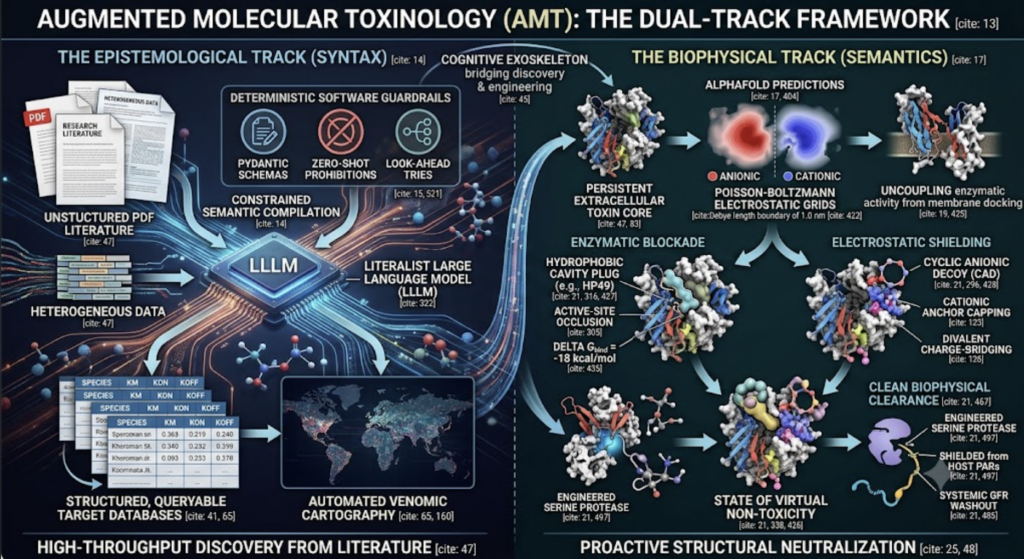
AMT is proposed as an emerging, unified, and interdisciplinary scientific branch designed to bridge the gap between in silico literature curation and de novo biophysical engineering. It shifts the paradigm of envenomation care from passive, reactive monitoring to Proactive Structural Neutralization. The framework operates on a “dual-track” architecture:
- The Epistemological Track (Syntax): This track employs Constrained Semantic Compilation to safely harvest and synthesize unstructured literature. By layering deterministic software guardrails over probabilistic AI models, the pipeline tethers data extraction directly to primary source coordinates, neutralizing Linguistic Latent-Layer Noise (LLLN) and algorithmic smoothing. The LLLM (Literalist Large Language Model) acts as an automated venomic cartographer, building structured, queryable databases from raw data.
- The Biophysical Track (Semantics): This track analyzes the 3D surface charge topologies and molecular dynamics of target toxins, utilizing high-confidence AlphaFold structural predictions and Poisson-Boltzmann electrostatic potential grids. This track establishes the rules for uncoupling a toxin’s enzymatic activity from its membrane-docking mechanism. Researchers can design synthetic, bioengineered “cavity plugs” and rigid Cyclic Anionic Decoys (CADs) to achieve a state of Virtual Non-Toxicity. This is followed by clean biophysical clearance using an engineered serine protease specially shielded from host Protease-Activated Receptors (PARs).
This comprehensive framework does not seek to replace human experts but provides a high-fidelity Cognitive Exoskeleton, enabling researchers to decode complex venomic systems in silico and deliver targeted, preventative interventions at modern speeds. While primarily designed for toxic envenomation systems, the platform holds theoretical potential for translating into molecular virology to address parallel cellular attachment and entry dynamics.