A teaser
In modern molecular toxicology, researchers face a critical bottleneck: extracting, indexing, and synthesizing disparate biological, clinical, and structural data from heterogeneous public databases (e.g., NCBI PubMed, PubChem PUG-REST, EMBL-EBI OLS, and AlphaFold) is manual, slow, and prone to cognitive overload. We present a custom full-stack, single-screen interactive Directed Acyclic Graph (DAG) platform designed to orchestrate high-throughput computational toxicology pipelines. By employing an auto-arranging, cable-driven topological sorting algorithm, the system dynamically maps and sequences data-retrieval and synthesis nodes. When multiple modules occupy the same execution level, a user-configurable sequence priority override resolver prevents race conditions and strictly schedules processing. Furthermore, we introduce separated Heuristic Guidelines and API Directives that feed directly into live endpoints and server-side LLM payloads, allowing researchers to inject custom query parameters and constraints. This work demonstrates a highly safe, interactive, and modular environment for rapidly profiling toxic substances while adhering to strict chemical safety guardrails.
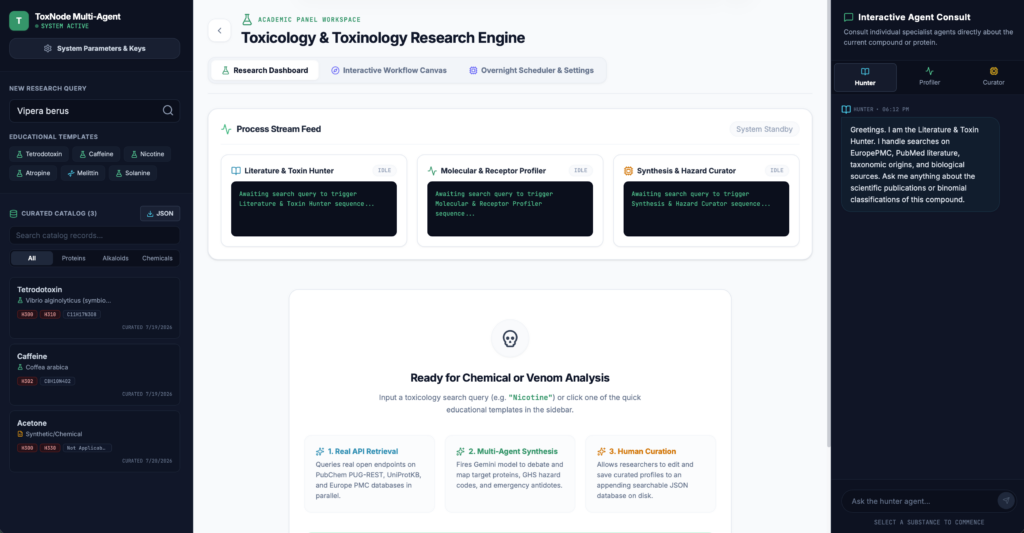
Identifying the clinical and structural characteristics of venoms, neurotoxins, and synthetic compounds requires consulting multiple siloed databases. An analyst must typically query PubChem for structural properties, search PubMed for toxicological literature, query ontology databases like ChEBI or Gene Ontology to index biochemical families, fetch 3D structures from AlphaFold, and finally compile a synthesized safety and medical countermeasure profile.
This process is highly disjointed. To address this, we engineered an interactive computational toxicology environment. The platform allows users to model data flows visually using a DAG visual canvas, configure retrieval parameters under double-click menus, and execute complex workflows sequentially. The primary research and engineering objectives of this software are:
- Visual Automation of Siloed Pipelines: Unifying chemical property, literature, ontology, and structural coordinate retrieval.
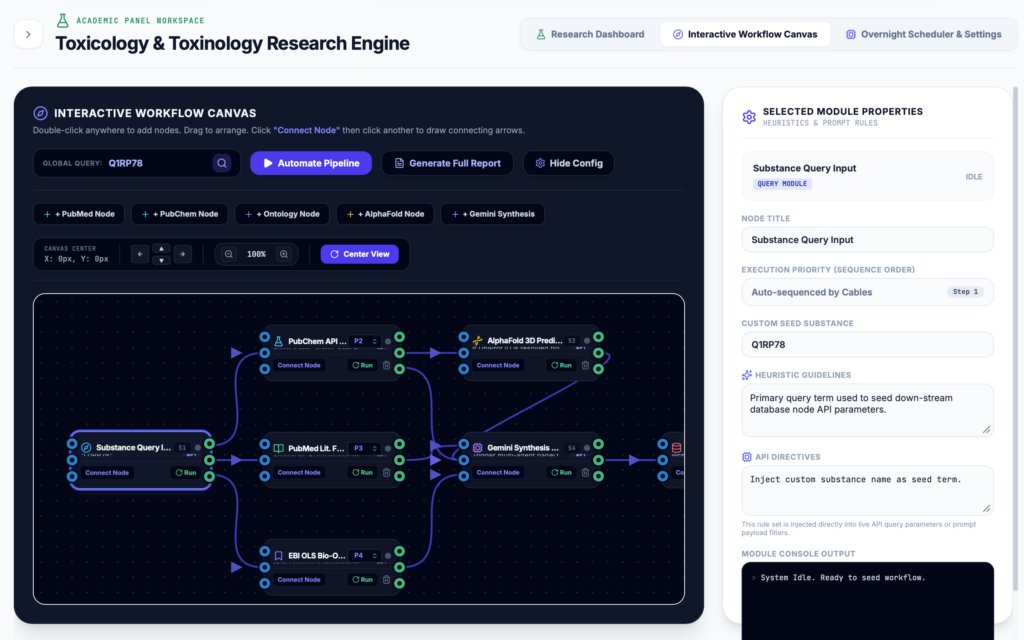
- Topologically Sound Execution (Cables and Override Priorities): Running the entire pipeline in a clean, fully sequential sequence determined dynamically by connection “cables”, using manual override priorities exclusively to resolve same-step ties.
- Decoupled Rule Injection: Separating qualitative guidelines (Heuristic Guidelines) from precise execution queries (API Directives) to feed downstream APIs and the LLM panel.

Eliminating “UI Slop” and Aesthetic Integrity
In designing this application, we explicitly rejected the modern trend of decorating scientific tools with flashy system logs, ping speeds, or meaningless terminal displays (often referred to in design circles as “tech-larping” or “AI slop”).
The canvas instead relies on deep slate color schemes, Inter typography, and JetBrains Mono accentuation to establish visual authority. Micro-animations (powered by motion) give smooth, spring-based movement to drag-and-drop nodes and connector paths, creating a highly tactile experience.
The software can be tested at this link, after applying for access and being approved.