A Paradigm Shift in Environmental Toxicology. Environmental toxicology is undergoing a paradigm shift. For years, researchers relied on traditional homology modeling tools like SWISS-MODEL to predict protein structures. Today, the integration of AlphaFold’s highly accurate ab initio 3D predictions is transforming how we assess environmental risks. A prime example is the screening of endocrine-disrupting chemicals (EDCs). Recent analyses utilizing the zebrafish androgen receptor demonstrate that AlphaFold-generated models offer superior structural stability.
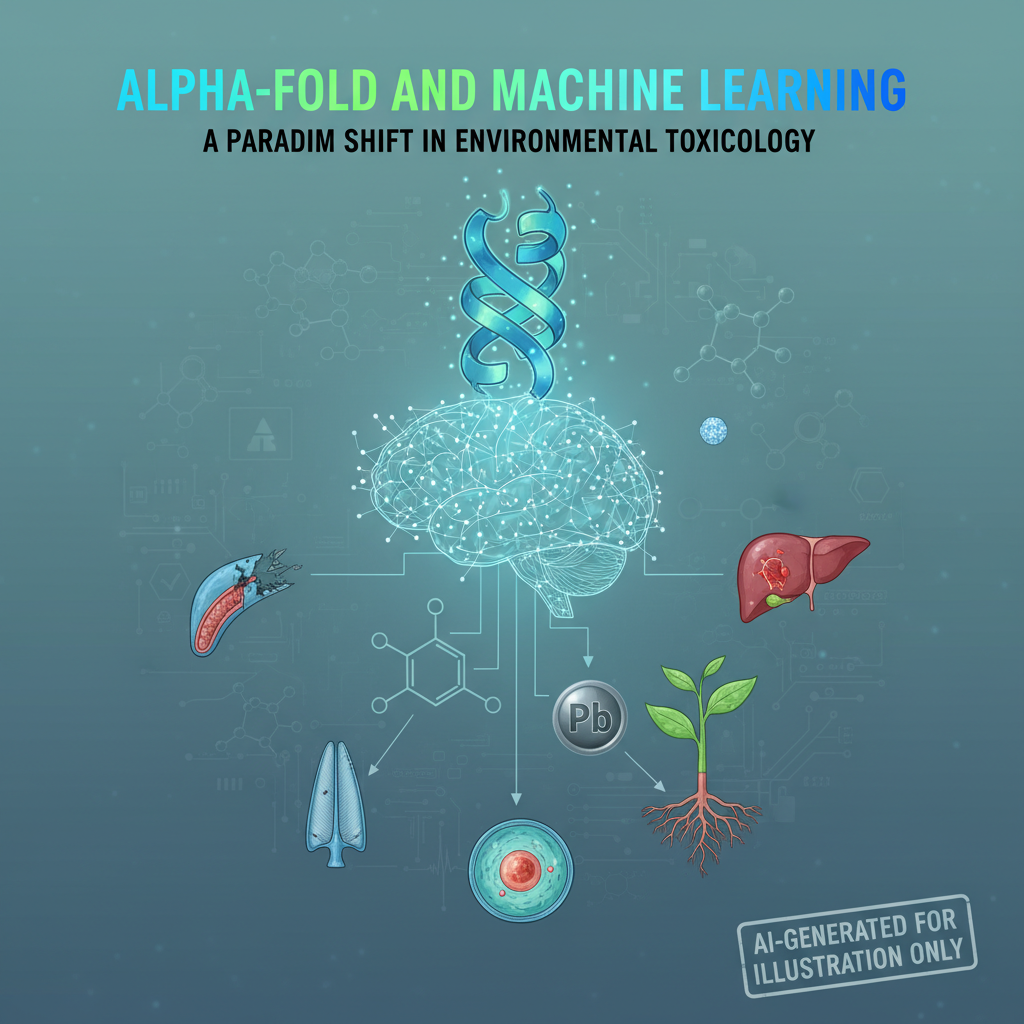
Moreover, AlphaFold-derived MMPBSA binding energies are statistically significant (p < 0.05) contributors to ligand-specific variance when compared to in vitro EC50 values, easily outperforming older techniques. Beyond direct screening, toxicologists are leveraging the expansive AlphaFold-2 database, which houses over 350,000 predicted protein structures, to train novel machine learning pipelines. These computational frameworks accurately quantify 3D protein similarities across diverse species. By mapping cross-species structural alignments, researchers can now optimize the selection of animal models for human toxicity testing with unprecedented precision. Ultimately, the fusion of high-fidelity structural predictions and advanced machine learning is elevating the accuracy of environmental risk assessments, moving the field past traditional limitations into a highly predictive, data-driven future.
Md Adnan Karim, Chang Gyun Park, Hyunki Cho, Annmariya Elayanithottathil Sebastian, Chang Seon Ryu, Juyong Yoon, Young Jun Kim ‘Leveraging AlphaFold models to predict androgenic effects of endocrine-disrupting chemicals through zebrafish androgen receptor analysis’
Source Access
Shreyas U Hirway, Xiao Xu, Fan Fan ‘A novel computational machine learning pipeline to quantify similarities in 3D protein structures’
Source Access